The 2026 Guest Check-In Playbook: Why the First 30 Minutes Decide Your Whole Event
Every experienced hostess and planner knows a quiet secret: a night is usually won or lost in its first thirty minutes. Not during dinner, not during the speeches — at the door, when a room's worth of guests all arrive within the same short window and expect to be welcomed, oriented, and seated without friction.
The 2026 data backs this up, and it points to a clear playbook for anyone running the front of an event. Here's what the numbers say, and what to do about them.
The data: the front door is where the pressure lives
Three findings from 2026 event check-in reporting are worth internalizing:
Arrivals cluster hard. Check-in activity peaks sharply in the first 30 to 60 minutes. Guests don't trickle in evenly — they show up around the stated start time, all at once. Whatever staffing feels comfortable for the rest of the night is often nowhere near enough for that opening surge.
Most events still run on manual name-search. Roughly 78% of check-ins still happen by a person scanning a printed or on-screen list for a name. It works — until forty people are waiting and each lookup takes fifteen seconds.
QR is rising fast. QR-based check-in grew four-to-fivefold within 2026, from a niche behavior to a mainstream one. Guests increasingly expect to scan and go, the way they already board flights and order dinner.
And most events fund one door. The majority of check-in-enabled events operate a single station. One point of entry plus a clustered arrival spike equals one long queue — the exact thing guests remember and complain about.
Put together, the picture is simple: the hardest, most-remembered moment of an event is under-resourced almost everywhere.
The playbook: turn the surge into a guided welcome
You can't spread out when guests arrive. You can change how much friction each arrival creates. Four moves:
1. Let guests self-locate
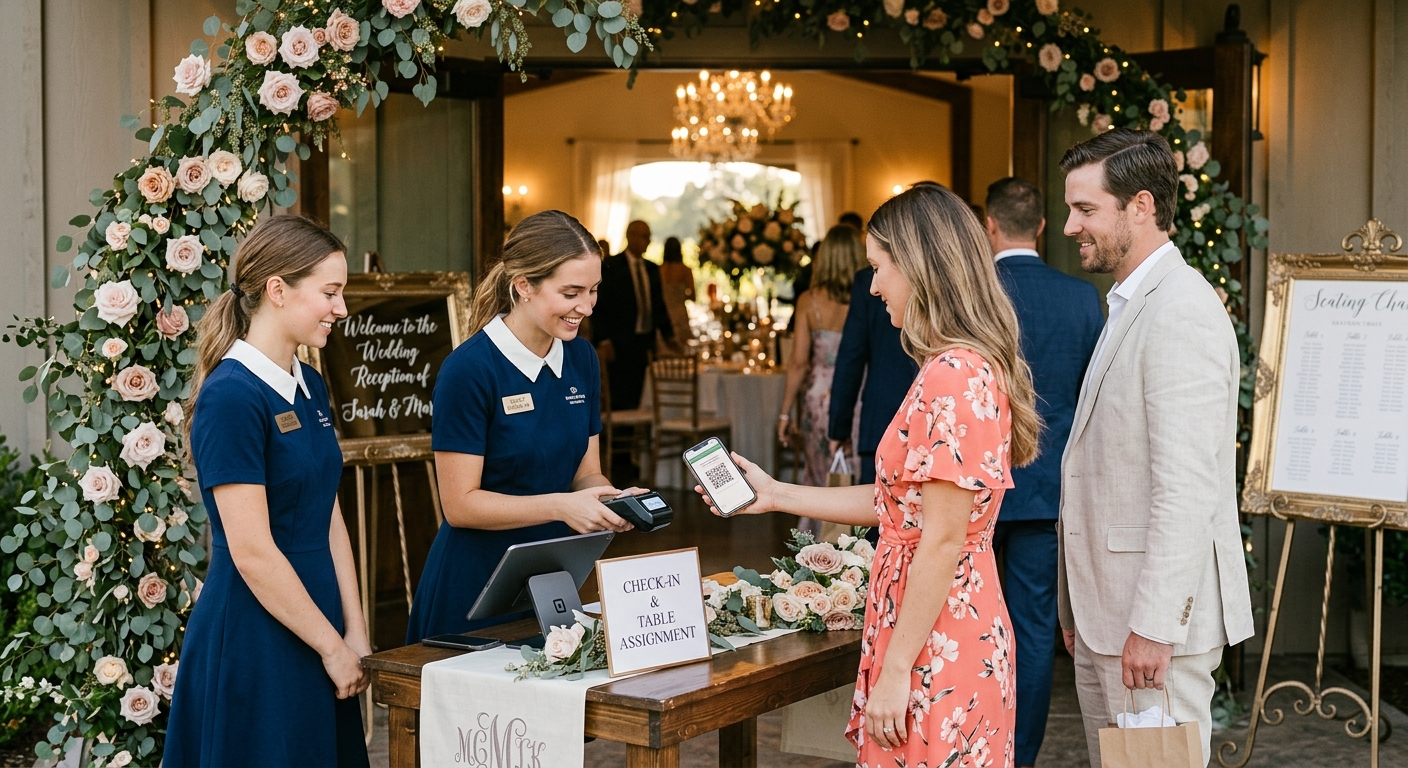
The fastest queue is the one that never forms. When guests can scan a QR seat finder and be walked to their own table by their phone, a huge share of "where do I sit?" traffic never reaches a human at all. The single station stops being a chokepoint because most guests route around it.
2. Give every hostess the same live list
Manual name-search isn't slow because it's manual — it's slow because it's usually one person with one list. When every hostess on the floor is searching the same live guest list from her phone, you've turned one door into many. Any team member can answer any guest, anywhere in the venue.
3. Plan for the first 30 minutes specifically
Staff the opening surge, not the average. If industry guidance puts greeters and ushers at roughly one per 50 guests, that ratio is a floor for the arrival window, not the whole night. Concentrate your people at the entrance for the first half-hour, then redeploy them once the room settles.
4. Make last-minute changes invisible
Walk-ins and surprise plus-ones are a normal part of every arrival rush — a meaningful share of check-ins involve guests added on-site. If adding or re-seating a guest means editing a printed chart, the queue stops moving. If it's a tap on a live floor plan that updates for the whole team at once, the line never notices.
Why this matters more at scale
For a 100-guest event, a rough front door is a minor blemish. For the 500- and 800-guest weddings common across Lebanese and Arab celebrations, the arrival surge is a genuine logistics event — and it's the first impression every single guest forms. Getting it right is the clearest signal that a hostessing team is operating at a professional level.
That's exactly the gap modern tools close. A team running on a live, shared floor plan with QR self-seating doesn't just survive the first thirty minutes — it makes them feel effortless, which is precisely what clients remember and rebook.
This is the kind of front-door operation Cedar Invites is built for. See how it equips hostessing teams and event professionals.